
1
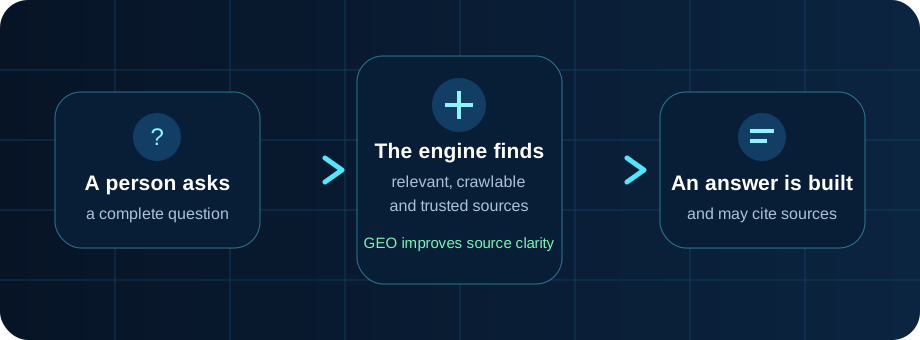
The person asks
The search is often a full question, such as “Which type of website is best for a local accountant?”
GEO is the work of making online content easier for AI-powered search and answer systems to discover, understand and use when responding to relevant questions.
This page explains what GEO means, how it relates to SEO, what actually helps and what website owners should ignore.

The short answer
Generative Engine Optimization is the process of improving content and website information so that generative search systems can understand it and consider it when building an answer.
GEO does not replace useful content, normal SEO or a technically sound website. It adds stronger focus on clear entities, direct answers, trusted evidence and information that is easy to extract accurately.
GEO in five minutes
A generative system does not simply display ten blue links. It may gather information from multiple sources, compare it and build a direct response for the user.
The search is often a full question, such as “Which type of website is best for a local accountant?”
It may use indexed web pages and other available information to identify relevant facts and sources.
The final response may summarise information, compare options and include links or citations to selected sources.
A simple example
GEO becomes easier to understand when you stop thinking about algorithms and start thinking about the information needed to answer a real question.
An answer system needs clear, verifiable information. A website that only says “quality service at great prices” gives very little useful evidence.
GEO is partly about making this useful information obvious, consistent, crawlable and easy to understand.
Why GEO matters
Search still matters, but the way information is presented is changing. Businesses need pages that can work as useful sources—not pages filled with vague marketing language.
Generative systems can combine information from several sources rather than relying on one page alone.
The website must explain the entity, service, audience and evidence without making the reader guess.
A page might be linked, cited, paraphrased or simply used as supporting context, depending on the system.
GEO vs SEO
Google’s official guidance says established SEO best practices remain relevant because its generative features use core Search ranking and quality systems.
| Area | Traditional SEO | Generative Engine Optimization |
|---|---|---|
| Main outcome | Discovery and visibility in search results | Clear understanding and possible use inside generated answers |
| User behaviour | Searches, scans results and chooses a page | Asks a complete question and receives a synthesised response |
| Shared foundations | Helpful content, crawlability, technical quality, authority, relevance and a strong user experience | |
| Extra GEO emphasis | Not the main focus | Direct answers, clear entities, extractable evidence, comparisons and source-worthy information |
| Guarantees | No guaranteed rankings | No guaranteed citations or recommendations |
What actually helps
These are practical foundations that improve the chance of a website being understood. They also make the website better for real visitors.
Use a consistent business name, service description, audience, location and contact information.
State the answer clearly, then explain it. Do not hide the useful information beneath a long introduction.
Add real experience, examples, comparisons, processes and evidence that generic pages do not provide.
Important content must be public, accessible through normal links and technically eligible for indexing.
Support claims with qualifications, methods, public profiles, policies, examples and other genuine evidence.
Use one clear H1, useful headings, short sections, lists and comparison tables where they improve understanding.
Use JSON-LD to describe visible content accurately. Never invent reviews, ratings, people or results.
Make the page stable, readable and easy to use on phones as well as desktop computers.
Good GEO practice
Weak or misleading practice
Beginner action plan
You do not need an expensive tool to begin. Start by improving the information already visible on the website.
Include what you do, who you help and the main place or market you serve.
Explain the problem, service, process, suitability, limitations and next step.
Turn those questions into visible, direct answers across useful pages.
Use real examples, public information, qualifications, screenshots or transparent methods where appropriate.
Review robots rules, indexing, canonical URLs, mobile rendering and internal links.
Describe the organisation, website, page and visible FAQs without inventing information.
Use Search Console, real customer questions and observed AI citations as evidence—not assumptions or guarantees.
60-second self-check
Tick every statement that is already true. The score is calculated in your browser and is not sent anywhere.
This is a simple educational check, not a complete technical audit or a promise of AI visibility.
Frequently asked questions
Generative engine optimization, or GEO, is the work of making digital content easier for AI-powered search and answer systems to discover, understand and use when responding to relevant questions.
No. GEO builds on many SEO foundations, including crawlability, useful content, authority and technical quality. For Google Search, official guidance says established SEO best practices remain relevant to generative AI features.
SEO traditionally focuses on discovery and visibility in search results. GEO adds more emphasis on making information clear, extractable and suitable for possible use inside a generated answer. The two overlap heavily.
GEO can improve the quality and clarity of the information available about a business, but it cannot force ChatGPT or any other AI system to recommend it. No ethical provider can guarantee a recommendation.
No. Google states that special AI text files or new markup are not required for its generative AI search features. A normal crawlable website with strong content and technical foundations remains the priority.
No. Accurate schema can help systems understand page content, but it does not guarantee a rich result, ranking or citation. The markup must match the visible page.
No. Small businesses can begin with clear service information, customer questions, local details, genuine proof and a fast, accessible website.
There is no fixed timeline. Crawling, indexing, ranking and AI-source selection are controlled by external systems. The realistic goal is continuous improvement rather than an instant result.
Primary sources
These sources provide the strongest starting point for understanding GEO research and Google’s current position on generative AI search.
A soft next step
Send KRONATRIX your website and one customer question you want the site to answer. We will review the visible clarity, content structure and basic GEO foundations.
KRONATRIX authority network
Each KRONATRIX website focuses on a separate question, audience or service instead of repeating the same page under different keywords.